Acknowledging God and Truth: The Founding Mottos on Canadian University Emblems
- Brady Loenhart
- October 7, 2025
- 10 mins
- Education History
- academic freedom canadian history education faith heraldry latin mottos truth universities
“Τὰ Πάντα Ἐν Χριστῷ Συνέστηκεν” — All Things Hold Together in Christ.
This audacious declaration, taken directly from Colossians 1:17, is the official motto of McMaster University. It makes a bold claim: Christ is the integrating principle of all knowledge. Every discipline, every field of study finds its coherence and meaning in Him.
The Latin mottos emblazoned on the shields of Canadian and American universities reveal something profound: our most prestigious academic institutions were built on foundations of faith, truth-seeking, and divine wisdom. In an era where universities face unprecedented challenges, from bitter polarization to restrictions on open dialogue, there’s wisdom in examining these founding mottos as potential guideposts for renewal.
Mottos like Harvard’s past “Veritas Christo et Ecclesiae” (Truth for Christ and the Church) or “Quaecumque Sunt Vera” (Whatsoever Things Are True) at St. Francis Xavier and the University of Alberta show an unwavering commitment to truth as something sacred and transcendent. These institutions believed truth existed and was worth pursuing with everything they had. They understood that real academic freedom flows from humility: acknowledging that truth is bigger than any individual or ideology.
The Emblems That Speak: A Non-Exhaustive Collection
What follows is a curated collection of university mottos that particularly resonated with me. This is by no means an exhaustive list—there are many more Canadian institutions with equally inspiring mottos—but these represent examples that speak powerfully to the founding vision of higher education. Few American examples provided as well.
Acadia University
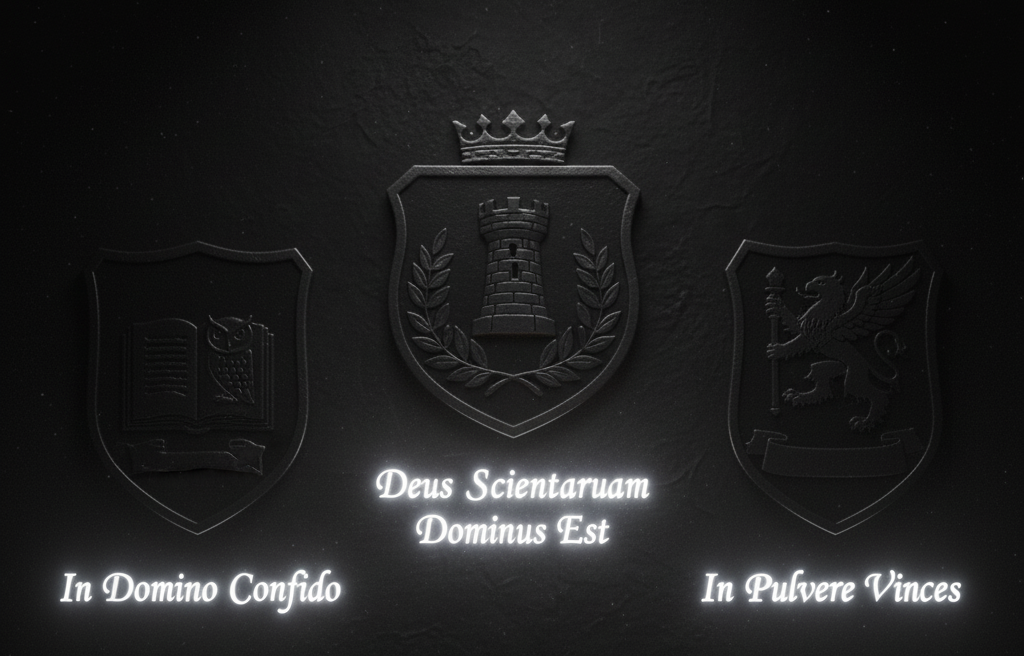
In Pulvere Vinces
In Dust Thou Shalt Conquer
This striking motto speaks to humility as the foundation of true achievement. The dust imagery evokes both human mortality and the fertile ground from which great things grow. It’s a reminder that lasting victories come not from pride or power, but from recognizing our humble origins.
Bishop’s University
Recti Cultus Pectora Roborant
Sound Learning Strengthens the Spirit
This motto beautifully captures the holistic vision of education—not merely filling minds with information, but strengthening the human spirit itself. Learning, when done rightly, fortifies the soul.
Dalhousie University
Ora et Labora
Pray and Work
The ancient Benedictine motto adopted by Dalhousie encapsulates the integration of spiritual life and practical action. True education requires both contemplation and labor, prayer and effort working in harmony.
McGill University
Grandescunt Aucta Labore
By Work, All Things Increase and GrowAnd on the family crest:
In Domino Confido
I Trust in the Lord (from Psalms)
McGill’s dual mottos present both human effort and divine trust. Growth requires labor, but the foundation is confidence in God. This balance between human agency and divine providence characterized the vision of education.
McMaster University
Τὰ Πάντα Ἐν Χριστῷ Συνέστηκεν
All Things Hold Together in Christ (Colossians 1:17)
This direct Biblical quotation in Greek makes an audacious claim: Christ is the integrating principle of all knowledge. Every discipline, every field of study, finds its coherence and meaning in Him. This wasn’t sectarian education; it was education grounded in the belief that all truth is ultimately unified.
Mount Allison University
Litterae, Religio, Scientia
Literature, Religion, Science
The trilogy speaks volumes: authentic education requires the humanities (literature), spiritual formation (religion), and empirical investigation (science). Not one at the expense of others, but all three integrated as essential components of learning.
Queen’s University
Sapientia et Doctrina Stabilitas
Wisdom and Knowledge Shall Be the Stability (inspired by Isaiah 33:6)
Drawing from Isaiah’s prophecy, Queen’s motto identifies wisdom and knowledge as the foundation of societal stability. Not military might, not economic power, but the pursuit of truth provides lasting security.
St. Francis Xavier University
Quaecumque Sunt Vera
Whatsoever Things Are True (Philippians 4:8)
Another direct New Testament quotation, this motto from Paul’s letter to the Philippians establishes the breadth of truth-seeking. The “whatsoever” is crucial: truth is truth, wherever it’s found, and all of it worthy of pursuit.
The University of Regina
As one who serves (Luke 22:27)
Drawing from Jesus’s teaching about servant leadership, Regina’s motto frames education as preparation for service rather than power. Knowledge exists not for personal advancement but for serving others.
Université Laval
Deo Favente Haud Pluribus Impar
By God’s Favor, Not Unequal to Many
This motto acknowledges that any accomplishment ultimately depends on divine favor. Human achievement, including academic excellence, is a gift requiring humility and gratitude.
University of Alberta
Quaecumque Vera
Whatsoever Things Are True (Philippians 4:8)
Sharing a similar motto with St. Francis Xavier, the University of Alberta embraced the same comprehensive commitment to truth from all sources.
University of Ottawa
Deus Scientiarum Dominus Est
God is the Master of the Sciences
A bold theological claim: God is not only the creator but the master of all sciences. This motto positions every academic discipline as ultimately under divine authority and coherence.
University of Saskatchewan
Deo et Patriae
For God and Country
Education serves two masters: divine purpose and national flourishing. Service to God and service to country were understood as complementary, not competing loyalties.
Western University
Veritas et Utilitas
Truth and Usefulness
Western’s motto balances the pursuit of truth with practical application. Knowledge should be both true and useful, combining intellectual rigor with real-world benefit.
Wilfrid Laurier University
Veritas Omnia Vincit
Truth Conquers All
A personal favorite (my alma mater). This motto makes perhaps the boldest claim of all: truth doesn’t just exist, doesn’t just matter, it conquers. Not through force or coercion, but through its inherent power. The coat of arms features symbols of Canadian identity, Lutheran heritage, and learning, with a beaver bearing the torch of enlightenment. If truth really does conquer all, then we have nothing to fear from honest inquiry. This motto isn’t defensive; it’s confident in truth’s ultimate victory.
What about some well-known American examples? They follow the same pattern and help illustrate just how widespread these founding principles were.
Harvard University
Veritas
TruthHistorically also: Veritas Christo et Ecclesiae
Truth for Christ and the Church
Perhaps the most famous academic motto in the world, Harvard’s simple declaration of “Truth” once carried a fuller meaning. The original motto explicitly connected truth-seeking to Christ and the Church, acknowledging that ultimate truth had a divine source.
Princeton University
Dei Sub Numine Viget
Under God’s Power She Flourishes
Princeton’s motto exemplifies the same principle seen across Canadian institutions: flourishing depends on divine power. Academic excellence isn’t self-generated but rooted in God’s blessing.
Columbia University
In Lumine Tuo Videbimus Lumen
In Thy Light Shall We See Light (Psalm 36:9)
This example parallels Canadian thinking: human understanding depends on divine illumination. We see light (truth, knowledge, wisdom) only in God’s light. This motto elegantly captures the epistemological humility that characterized these institutions.
The Pattern: Truth as Sacred, Wisdom as Divine
Looking across these mottos, a clear pattern emerges:
Truth is not subjective or negotiable: it’s something to be discovered, pursued, and served. Institutions like Harvard, St. Francis Xavier, and the University of Alberta declared their commitment to “whatsoever things are true,” suggesting truth exists independently of human opinion.
Divine wisdom grounds all learning. From McMaster’s “All things hold together in Christ” to Ottawa’s “God is the Master of the Sciences,” these institutions saw God as the ultimate source and integrator of knowledge.
Humility precedes excellence. Whether it’s Acadia’s “In Dust Thou Shalt Conquer” or Laval’s acknowledgment of divine favor, these mottos reflect institutions that understood human achievement requires recognizing something greater than ourselves.
Education serves higher purposes. Mottos referencing service (Regina), stability (Queen’s), and both God and country (Saskatchewan) frame education as fundamentally about serving transcendent goods, not merely personal advancement.
When Universities Remembered Their Foundations
These mottos weren’t marketing slogans; they were foundational declarations of what these institutions existed to do. When McGill declared “I Trust in the Lord” or McMaster proclaimed that “All Things Hold Together in Christ,” they were making philosophical and theological commitments about the nature of truth, knowledge, and education itself.
The founders understood something we’ve largely forgotten: genuine intellectual freedom requires acknowledging that truth is bigger than us. When you believe truth is transcendent and sacred, you approach learning with both confidence and humility. Confidence that truth exists and can be found, humility that you don’t possess it completely and must remain open to correction.
This paradoxically creates more space for disagreement and debate than modern relativism. If truth is just subjective preference, then disagreement becomes personal attack. But if truth is transcendent and worth pursuing together, then disagreement becomes collaborative investigation. Iron sharpens iron precisely because both believe the blade can actually become sharper, that truth can be approximated more closely through rigorous engagement.
The Modern Challenge: Can We Recover What We’ve Lost?
Today’s universities face unprecedented challenges:
- Political polarization that makes genuine debate nearly impossible
- Speech restrictions that limit inquiry in the name of protecting feelings
- Ideological conformity that punishes dissent and rewards groupthink
- Loss of shared purpose as institutions fragment into competing identity groups
- Erosion of trust as universities are seen as partisan actors rather than truth-seekers
Is it coincidence that these problems intensified as universities abandoned their founding principles? When Harvard quietly dropped “Christo et Ecclesiae” from its motto, keeping only “Veritas,” did it lose something essential: the grounding that made truth-seeking meaningful?
When institutions stopped believing in transcendent truth, they became unmoored. If there’s no truth to discover, only power to exercise and narratives to construct, then universities become merely battlegrounds for competing ideologies. The strongest narrative wins, not the truest one.
Conclusion
These mottos aren’t gathering dust in archives. They’re invitations to remember what made these institutions great. When universities anchored themselves in transcendent truth, they created spaces where iron sharpened iron, where disagreement coexisted with respect, and where pursuing knowledge was itself an act of reverence.
The path forward isn’t found in new policies or political victories. It’s in recovering what we’ve forgotten. When institutions recognize truth as sacred rather than subjective, wisdom as divine rather than merely human, and learning as service rather than power, genuine diversity of thought can flourish. History proves the point: academic freedom hasn’t been threatened by acknowledging God. It has thrived under such acknowledgment.
Imagine for a moment: what would our world look like if those who wield political and corporate power lived as though they stood before an all-knowing God—One from whom no truth can be hidden, before whom no deception stands? What transformation might unfold if our leaders governed not merely by opinion polls and profit margins, but with the fear and reverence due to One who sees everything?
“In Lumine Tuo Videbimus Lumen” (In Thy Light Shall We See Light). This isn’t religious imposition. It’s a return to the humility and wonder that makes true learning possible. If truth really does conquer all, then we have nothing to fear from honest inquiry and open debate.
The foundation stones are still there, inscribed with wisdom from centuries past. The question is whether we have the courage to build on them again.
— Brady
P.S. Maybe we should dare to ask ourselves why the Canadian Charter of Rights and Freedoms itself opens with a preamble that reads:
Whereas Canada is founded upon principles that recognize the supremacy of God and the rule of law:

Notice that colon. In my opinion, it’s the single most powerful colon in Canadian law, connecting every freedom that should be afforded to you in Canada with one simple statement. The freedoms that follow don’t exist in a vacuum. They flow from foundational principles: the supremacy of God and the rule of law.
Perhaps Canada’s universities and Canada’s Charter were both trying to tell us something we’ve been too eager to forget.
Note: This is a non-exhaustive collection of university mottos that particularly resonated with me. Many other Canadian institutions have equally inspiring founding principles worth exploring. For official heraldry information, please visit the Canadian Heraldic Authority and individual university websites.